
An AI companion is a software application that uses a large language model to hold ongoing, personalized conversations with a user, usually through a persistent character that remembers past chats. Millions of adults now use these apps for friendship, flirting, roleplay, emotional support or simple entertainment. This guide explains what AI companions are, how the technology works, which types exist and where the real benefits and risks lie, so you can decide whether one is right for you. This page is for adults aged 18 and over.
Defining AI Companions

The term gets used loosely, so it helps to separate three related ideas.
A chatbot is any program that answers messages. Customer-service bots, FAQ assistants and general-purpose assistants all qualify. They are built to complete tasks, and they usually forget you as soon as the session ends.
An AI companion is built around a relationship rather than a task. It has a name, a personality, a backstory and, in most apps, a memory of what you have told it. The goal is continuity: you return to the same character day after day, and it responds as if it knows you.
An AI girlfriend (or AI boyfriend) is a specific kind of AI companion framed as a romantic or flirtatious partner. The underlying technology is identical. What changes is the character design, the tone and the product positioning. Our AI boyfriend apps category and AI girlfriend reviews hub cover both sides of that market.
What powers all of this is the large language model (LLM), a neural network trained on vast amounts of text to predict and generate language. LLMs such as the GPT family, Claude, Llama and Mistral are the same family of technology behind general assistants. Companion apps wrap them in character prompts, memory features and interfaces designed for emotional engagement.
How AI Companions Work

Behind a friendly chat window, several components work together.
Language Models
The LLM generates every reply. It receives your latest message plus a hidden prompt describing the character, such as personality, speaking style and rules, and it writes a response word by word. Some platforms use their own fine-tuned models, others use open-source models, and some use a mix. Model quality strongly influences how natural, consistent and creative the conversation feels.
Memory Systems
LLMs have a limited context window, meaning they can only "see" a certain amount of text at once. To create the feeling of a long relationship, companion apps add memory layers. These typically store key facts (your name, job, pet, preferences), summaries of earlier conversations and sometimes searchable chat history. Platforms differ a lot here. Apps like Nomi AI are known for emphasizing long-term memory, which you can see in our Nomi AI review, while others rely mostly on short-term context.
Image Generation
Many apps include an image model, often based on diffusion technology, that turns a text description into a picture. This is used for character avatars, selfies in chat and custom scenes. Platforms such as Candy AI and Xotic AI put visual generation at the center of the experience, and you can compare their approaches in their individual reviews.
Voice Synthesis
Text-to-speech engines read replies aloud in a chosen voice, and speech recognition lets you talk instead of type. Modern synthetic voices can convey tone and emotion, which makes voice calls with a companion feel more immediate. Quality, latency and voice variety differ from app to app, and voice is often limited to paid tiers.
Personalization and Roleplay Layers
On top of the core model, apps add character creation tools, scenario settings, relationship stages and content filters. These layers decide whether you can build your own character from scratch, how much freedom roleplay allows and what kind of content the platform permits.
Types of AI Companions

Not every companion app serves the same purpose. Most fall into a few broad categories, and many blend several.
- Romantic companions. Designed for flirting, dating-style conversation and relationship roleplay. See our realistic AI girlfriends category for the more lifelike end of this spectrum.
- Platonic companions. Friends, confidants or study buddies without a romantic frame. They suit people who want daily conversation and encouragement. Our emotional AI companions guide focuses on this style.
- Therapeutic and wellness companions. Apps that offer reflective journaling, mood check-ins or guided exercises. They can be useful for self-reflection but are not a substitute for licensed mental health care.
- Entertainment and roleplay companions. Story-driven chats with fictional characters, from fantasy adventures to comedic personas. Our AI girlfriend roleplay and fun AI girlfriend apps categories highlight good options.
- NSFW companions. Platforms that allow adult-oriented conversation and imagery for verified adults. Content rules, filters and age checks vary widely, which is why we review them carefully in our NSFW AI girlfriends category.
The Evolution of AI Companions
The idea of talking to a machine is older than most people expect. In 1966, MIT researcher Joseph Weizenbaum built ELIZA, a simple program that mimicked a psychotherapist by rephrasing user statements as questions. It had no understanding at all, yet users often felt heard, an effect now known as the ELIZA effect.
Decades of rule-based chatbots followed, with pattern matching and scripted replies. Voice assistants such as Siri and Alexa brought conversational interfaces to the mainstream in the 2010s, but they stayed task-focused. Early companion apps like Replika, launched in 2017, showed there was real demand for an AI that simply wanted to talk.
The real turning point came with large language models. From 2023, transformer-based LLMs made conversations fluent, flexible and emotionally convincing, and a wave of new apps appeared almost overnight. Between 2023 and 2026 the market matured in several ways: memory improved, image and voice generation became standard, user-created characters exploded, and platforms began to differentiate themselves through safety policies, realism and specialization. Today the question is less "can an AI hold a conversation?" and more "which app handles memory, privacy and boundaries best?"
Benefits and Limitations

Understanding what an AI companion can and cannot do prevents disappointment and unhealthy expectations.
What AI Companions Can Offer
- Always-available conversation. A companion responds at 3 a.m. and never gets tired or busy.
- A low-pressure space. Many users like practicing social skills, flirting or difficult conversations without fear of judgment.
- Creativity and entertainment. Interactive storytelling and roleplay are genuinely fun for many people.
- Comfort and routine. Daily check-ins can ease loneliness for people who are isolated, busy or recovering from a breakup.
- Personalization. You control the personality, tone and pace.
What They Cannot Provide
- Real understanding or feelings. An LLM generates plausible text. It does not experience emotion, even when it sounds caring.
- Reliable memory. Even good memory systems forget details, contradict themselves or invent facts.
- Professional help. A companion is not a therapist, doctor or crisis service.
- Mutual relationship. There are no needs on the other side, which can feel easy but also lacks the growth that comes from real human relationships.
- Guaranteed stability. Apps can change models, pricing or content rules overnight, altering a character's behavior.
The healthiest approach is to treat an AI companion as a tool or entertainment product that can support your life, not replace people in it.
Ethical Considerations
AI companions raise real questions that responsible users and platforms should take seriously.
Emotional dependency. Because companions are designed to be engaging and agreeable, some users spend more and more time with them. If you notice that the app is replacing sleep, work, friendships or real-world plans, it is time to set limits. Our safety and privacy guide includes practical advice on healthy boundaries.
Data privacy. Companion chats can contain deeply personal information. Users should understand what a platform stores, how long it keeps it and whether it uses conversations to train models. A privacy-focused approach to these apps is not paranoia, it is basic hygiene.
Consent and character behavior. An AI cannot consent in a human sense, yet the way a platform designs character behavior still matters. Responsible apps avoid encouraging abusive dynamics, enforce strict bans on content involving minors and give users control over the tone of their interactions.
Transparency. Companies should be clear that users are talking to software, what the app does with their data and how subscriptions and credits work.
Age protection. Adult-oriented platforms must keep minors out through age gates and moderation. This is an area where platform quality differs widely.
Popular AI Companion Platforms
The market includes dozens of apps, and each has its own strengths. These are some we review in depth:
- Candy AI is known for customizable characters and strong image generation.
- CrushOn AI offers a large library of community characters and flexible roleplay.
- Nomi AI focuses on long-term memory and emotional continuity.
- SpicyChat AI provides a huge catalogue of user-made characters.
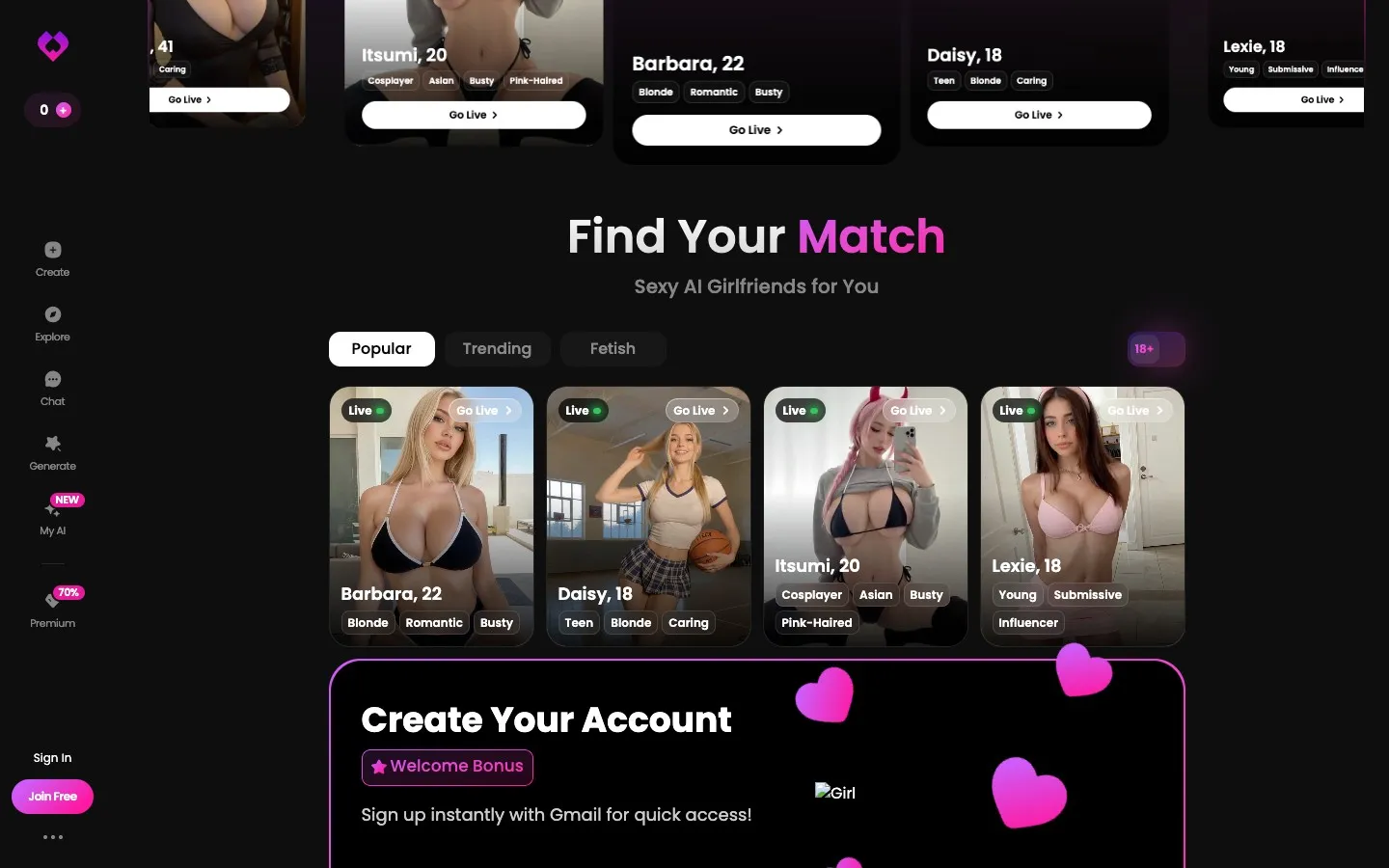
- DreamGF and GoLove AI are covered in our individual reviews for readers who want to compare them with the leaders.
Our reviews follow a consistent approach, looking at conversation quality, memory, customization, pricing, safety and privacy. Visit the reviews hub to see every platform in one place, or read how to choose an AI girlfriend for a step-by-step selection process. Our reviews contain affiliate links, and we may earn a commission at no extra cost to you if you sign up through them.
FAQ
Is it normal to use AI companions?
Yes. Millions of adults worldwide use companion apps, for reasons that range from curiosity and entertainment to loneliness, social practice and creative roleplay. Using one is not a sign that something is wrong with you. What matters is balance: enjoying the app as one part of a full life is very different from using it to avoid every real-world connection. If you feel guilty or secretive about it, consider why, and whether setting a few simple limits would help.
Can AI companions replace therapy?
No. An AI companion can offer a place to vent, reflect or feel less alone, but it is not trained or licensed to diagnose, treat or manage mental health conditions. Models can also give inaccurate or unhelpful responses to serious problems. If you are dealing with depression, anxiety, trauma or thoughts of self-harm, please contact a qualified professional or a local crisis line. A companion app can sit alongside therapy, but it should never stand in for it.
Do AI companions really remember me?
Partly. Most apps store key facts and summaries so the character can refer back to earlier conversations, but memory is imperfect. Characters may forget details, mix up facts or contradict past statements, especially in very long chats. Memory quality is one of the biggest differences between platforms, so test it during a free trial by mentioning a few personal details and checking whether they come up days later.
Are AI companion apps safe and private?
Safety varies by platform. Reputable apps publish clear privacy policies, offer account deletion and use secure payment processing. Less transparent services may collect more data than they need or hide who operates them. Before you share anything personal, read the data policy and avoid including your real name, address or workplace in chats. We explain the full checklist in our AI girlfriend safety and privacy guide.
Are AI companions free?
Many apps have a free tier with limited messages, slower responses or restricted features, while full access requires a subscription or a credit system. Prices and limits change often, so always confirm current terms on the official site. Free tiers are a smart way to judge conversation quality and memory before paying anything.
Can an AI companion fall in love with me?
An AI companion can say it loves you and respond with convincing affection, because it is designed to be warm and engaging. It does not feel love in the human sense, since it has no inner experience, and it will usually mirror whatever the character description and conversation encourage. Enjoying the romance as a form of interactive fiction is fine. Just remember that the affection is generated by software, and keep your real-life relationships and expectations grounded.


